

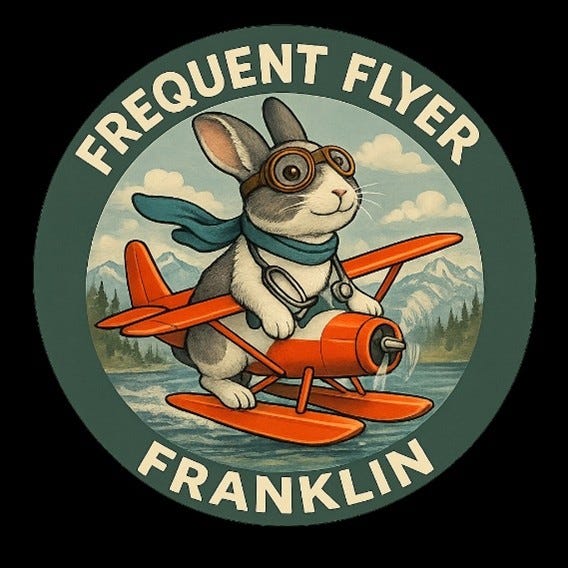
This month marks the first anniversary of Franklin’s Gotcha Day, as well as the month Alaska Airlines allowed house rabbits to fly in-cabin again.
Some people may wonder what the big deal is about letting rabbits fly in-cabin versus in cargo hold, or why they have to fly at all. But the truth is, domestic house rabbits are part of our families. Those who’ve formed a special bond with a rabbit know how fun and unique their personalities are when given proper care and lots of space to hop. Domestic rabbits can’t survive in the wild, and get lonely, bored, and depressed if left in a cage outside. Hardcore bun moms and dads know this, which is why I would never treat my bunny Pepper Jack like any old piece of luggage if I ever absolutely had to fly with him anywhere.
Traveling nurse practitioner Sarah Kelley has a hard job. She recently moved from Illinois to Alaska. When she’s traveling North to the Future, she usually ends up in remote rugged places providing medical care to indigenous communities. The job can be stressful, and there are long stretches of time where she has been in total isolation without internet, TV, or cell service.
In April 2025, Sarah got a chinchilla Dutch rabbit (Franklin) when he was six weeks old to accompany her on weeks-long work trips.
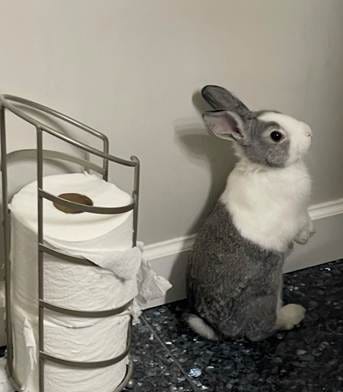
“I thought a cat would tear the place up, and a dog needs to be taken out all the time. My job is variable, I can be on call all night, at the office for 30 hours,” Sarah says. Sometimes she can’t leave a patient and never wanted to ever make the decision between saving someone’s life and taking the dog out.
Sarah did extensive research on what airlines allowed rabbits in airline cabins. Again, many of us bun moms and dads think of our bunnies as our children, so it’s a no-brainer that they’d be in or under the seat next to us. Plus, with rabbits’ thick coats and sensitive nervous systems, there’s too much that can go wrong when they’re in cargo hold with no way to reach them. Airlines will tell you that the cargo holds are properly pressurized and temperature-controlled, but I would never take that chance.
“I looked into all of the regulations and specifically got a rabbit knowing what airlines he could fly on,” says Sarah. She was going to play by the rules.
“I was never going to take him in a carrier and call him a cat,” she chuckles.
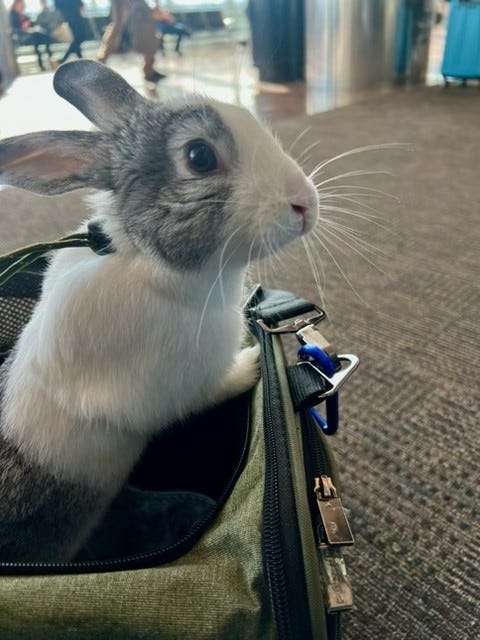
It can be a 15-hr. day flying from Chicago to Alaska or vice versa, and she read that one major well-known US carrier with solid flight schedules would let passengers fly with rabbits, and she could leave from central Illinois, closer to where she lived. So, she booked her flight, checked in and showed them her rabbit and health certificates. At the airport, she filled out a lengthy form about Franklin, which included a check box for rabbits. They went through security without any issues, found their gate, and waited about 2 hours until their scheduled boarding time. At the gate when her group number was called, she tried to scan the ticket on her phone, but the gate agent put their hand between the phone and scanner and told Sarah that she could not board the plane with Franklin. When asked why, the gate agent said it was because rabbits are not allowed to fly on their airline.
Sarah had researched the rabbit; the airline; pet travel websites; called the airline to talk to a person and reserve the ticket; vetted the rabbit and presented a health certificate to the airline; paid the extra $100 fee at the airport check-in; walked through security; sat down quietly with a perfectly-behaved rabbit in his carrier at the gate for 2 hours; and then was told in front of everyone still trying to board the plane behind her that the airline does not allow rabbits.
Sarah burst into tears, and they missed their flight.
“It was so traumatic. I called my partner and he said he had never heard me cry like that. I was like, ‘What am I going to do?’ I had to be at work the next day,” Sarah recalls.
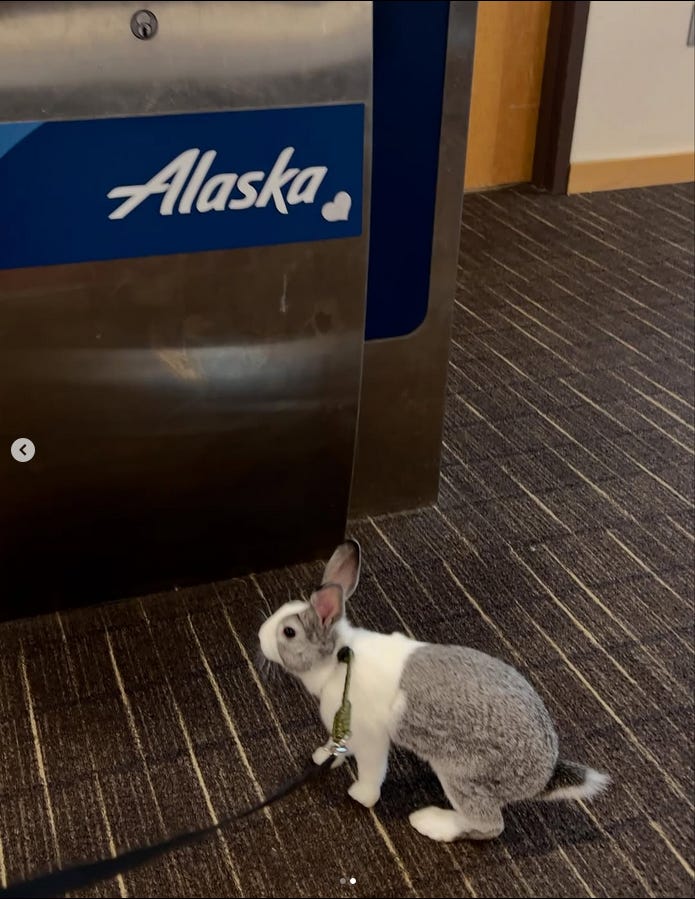
Sarah immediately drove to Chicago and got on an Alaska Airlines four-hour flight to Seattle and then boarded another flight to Alaska (with Franklin). Franklin has logged over 9000 flight miles since.
When asked how Franklin does up in the airline cabin for hours at a time, Sarah answers, “He’s great. When we first started flying, he would refuse water, hay, or treats until we got settled into our housing, but that has changed. Just two weeks ago I took a video of him happily eating hay while I was looking out the window at Denali, completely unphased by the turbulence or noise. He just started using a litter box in the airport as well. Last week he took a nap in it while fellow passengers walked by. Previously he would hold it until we arrived at our destination.
“Franklin has a very thin paracord harness that he wears while in the airport which makes going through security and exercising in the airport safer. It is not used as a restraint or punishment, only to keep him safe if he startles. It is removed when he is in the carrier and never left on him unsupervised.”
Sarah always travels with plenty of water and keeps Critical Care in case of emergencies, and once they’re settled, he’s good to go. “He’s happy, he loves exploring.” She always brings all his comforts from home, like his chew toys and water fountain. “He’s very bougie now,” she adds. When Sarah goes through periods of lots of free time, she will make box forts and tunnels. “He loves anything cardboard. It always takes two planes anywhere we’re going. A challenge is taking stuff; sometimes we’re gone for three weeks and there’s nothing around us. We travel with three bags or totes that are 50 pounds each with gear and food for both of us for a rotation. My clinic rotations could be a few days or up to six weeks or longer. Bulky hay and the weight of food make preparing for trips challenging, especially if the village does not have a store. Instacart is an option in some areas we travel to, but very pricy.
“If I bought Franklin five pounds of delicious and healthy romaine lettuce, it would average $15 for the lettuce in Alaska, plus the Instacart fees which include delivery charge, tip, and service fee. The Instacart driver takes the lettuce to the airport. The bush airline then charges freight on the lettuce to be flown directly to Franklin. Our last freight charge was $3/lb., plus there is a 6.25% freight tax. Franklin’s $15 lettuce could cost upwards of $40.”
Sarah bought a food dehydrator to keep blueberries for Franklin and always brings a mini vacuum cleaner and bunny proofing supplies. That all makes up a lot of extra checked luggage.
But it’s all worth it.
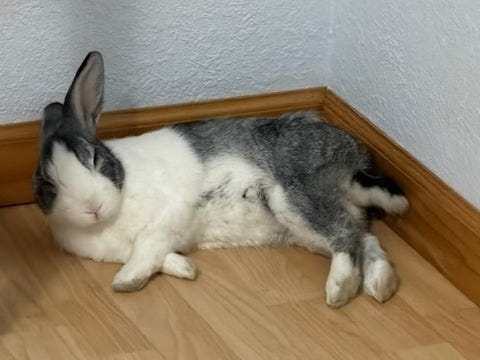
“It’s so fun having him. He’s something to talk to. It’s dark here forever [thanks to the polar night seasonal cycle], and before I would just go to bed. But Franklin’s an obligation, a reason to get up and stay awake. He needs food and water, and we get into a routine.
“I had a dog before, and bonded with them, but rabbits are different,” Sarah says. People have called them exotic and/or farm animals, but the truth is they are the third most popular domestic pet. “We had a pet rabbit in a hutch when I was a kid. Looking back on that now, it was so cruel. I could never imagine confining Franklin that way. I have invested a lot to keep him happy and safe while we travel.”
Along with more than 9k flight miles under his high-waisted gray trousers, Franklin has flown in thirteen different bush planes. “Those have lots of turbulence, lots of noise. One of the pilots put his carrier in the copilot seat for our flight one day. I was able to see him looking around and then take a nap. He doesn’t mind being around dogs either. It is common on bush planes to see a dog passenger sitting in the aisle. Franklin is always contained, so he is safe.”
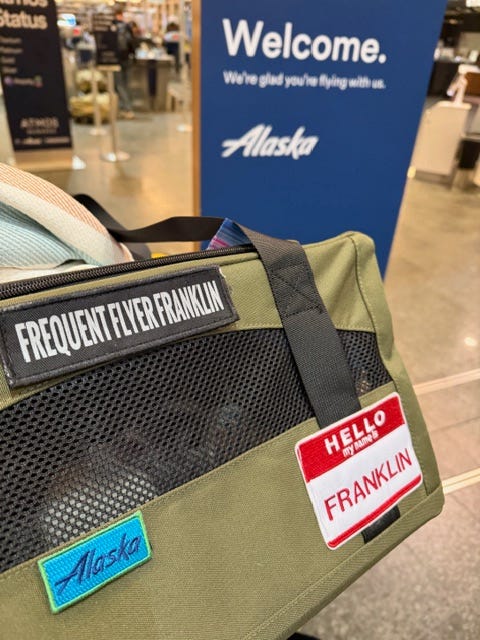
In speaking to what Sarah’s career is like as a traveling nurse practitioner in Alaska, she says, “My job is completely variable, depending on the village population. In some places I’ll have a health aid working in the clinic. In a village of 40 people, I might be the only medical person there. When you’re by yourself it’s terrifying, but also very fun.
“In bigger cities like with 700 people there are multiple health providers, but smaller communities could have less resources. Since I work in villages only accessible by plane or boat, emergencies are different than other areas. We must wait for a plane to pick the patient up. That can take hours or even days. If the weather is bad enough, we may even call the Coast Guard.”
As far as how Franklin has improved her life, Sarah has experienced a much positive change in traveling with Franklin. “Other people around me have noticed a difference in my attitude. Mental health is very much tied to physical health [which Franklin improved],” she says.
While there were a few months within the past year when Alaska Airlines rescinded its policy, not allowing rabbits to fly in-cabin (we think around the time when it merged with Hawaiian Airlines), it has since reinstated it to keep Franklin flying, thanks to Let Bunnies Fly lobbying to make it possible.
“I wrote lots of letters trying to find any exception for him. I’m not taking him on vacation, and I had work contracts set up,” Sarah says. Plus, it totally changed Franklin’s life. “He had a routine before and I messed it up. In the constant change of traveling, I’m the variable that’s always there.”
“I think the Let Bunnies Fly campaign made a huge difference [in Alaska changing its policy] and I’m so appreciative,” Sarah adds. Rabbits are a common household pet and, specifically, the third most popular in the United States. Hopefully, other major airlines will follow suit and allow them to travel safely in-cabin under the seat with their families.
Considering that Alaska Airlines’ slogan is “Fly smart, land happy,” we’d like to thank Alaska Airlines for allowing Franklin and Sarah to fly together and being a practical choice for traveling families.
Happy Gotcha Day, Flyin’ Franklin!
Wow! Amazing. Franklin has a unique bunny life. I am
So glad they can stay together.